
Lede
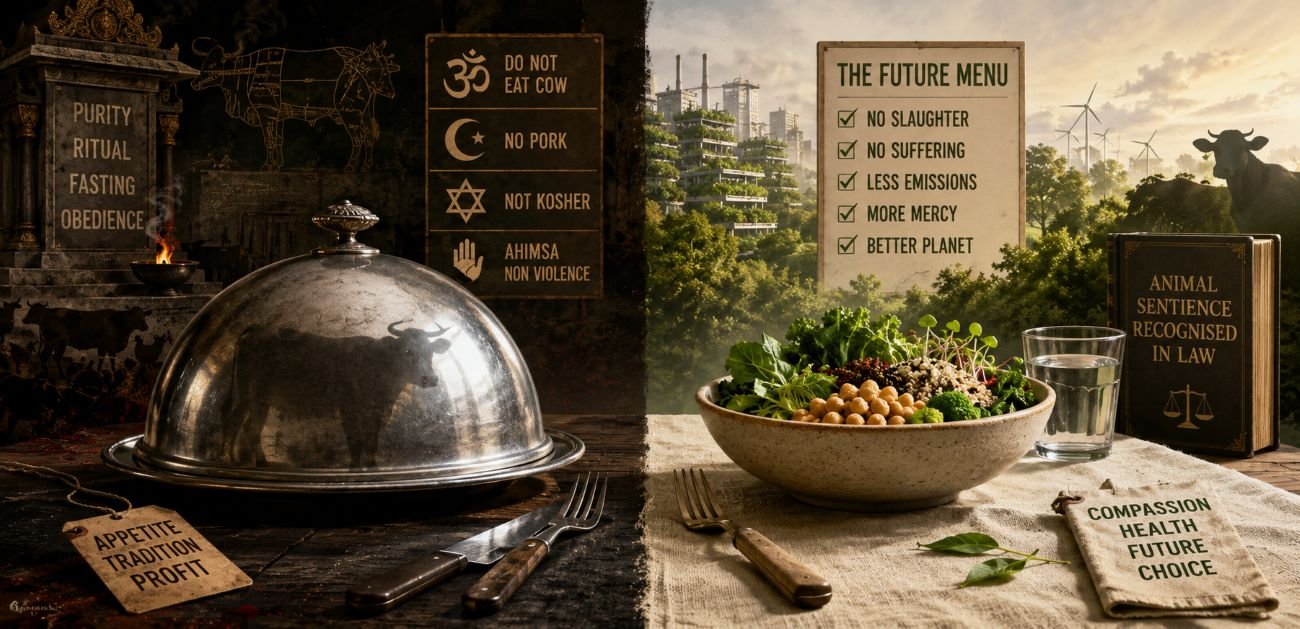
We built whole religions around purity, then built whole industries around pretending a suffering animal is only dinner with paperwork.
Beliefs, myths and the modern diet
Meat has never been just meat. In older religious systems, it often carried ideas of purity, pollution, discipline, sin, sacrifice, obedience, mercy, or spiritual heaviness. Hindu traditions shaped strong taboos around beef and cow protection. Jainism pushed ahimsa, nonviolence, so far that even root vegetables can become a moral problem. Buddhism treated harm to living beings as a spiritual obstacle, although practice varies by school and culture. Judaism and Islam built detailed food laws around what can be eaten, how it is killed, and what remains forbidden, especially pork and blood. Christianity kept fasting seasons and meatless days as forms of discipline. Shinto carried older ideas of pollution around certain animal flesh.
The modern diet keeps some of that ancient logic but changes the costume. The altar becomes the health plan. The fasting day becomes the detox. The purity rule becomes clean eating. The old fear of spiritual heaviness becomes fear of cholesterol, processed food, animal suffering, climate damage, or a body that refuses to behave after too many convenient meals. The myth has not disappeared. It has been rebranded with gym clothes, supermarket labels, and a podcast microphone.
This does not mean all religious food rules are the same, or that every vegetarian is secretly doing theology with chickpeas. It means the human mind keeps returning to the same question: what does this food do to me, to the animal, to the body, to the soul, and to the world around me? We used to ask it through priests and prophets. Now we ask it through nutrition labels and documentaries. Same table, newer cutlery.
Hermit Off Script
Meat eating has always carried more weight than a fork should hold. In many old religious traditions, meat was not treated as simple food, but as something that could disturb purity, prayer, fasting, ritual, or spiritual discipline. In Hinduism, the cow became sacred and protected, with its veneration traced back to the Vedic period. In Islam, pork is forbidden in Quran 5:3. In Judaism, pigs fail the kosher test because they have split hooves but do not chew the cud. Jainism goes further, putting nonviolence towards living beings at the centre of spiritual life. Buddhism is more mixed, but many monastic and Mahayana traditions still treat vegetarianism as a higher discipline. So the ancient world already knew something we now pretend is new: what we eat changes how we think about life. Today, many people avoid meat for health, diet, climate, or pity for animals, but somehow pity becomes very shy when the animal is not a dog, cat, or mascot in a Christmas advert. Chicken is dinner, lamb is roast, pig is bacon, cow is burger, dog is scandal. What a tidy moral supermarket. I don’t want to turn food into a new religion, because then we only exchange one altar for another. The point is simpler. If protein, iron, calcium, and other nutrients can be planned from vegetarian sources, the question becomes less about survival and more about habit. Hunger has made humans do terrible things, even to each other. Ritual has also been used to excuse terrible things. That does not mean every meat eater is evil. It means the future may look back at our plates and ask why our compassion needed a species label before it started working. We called it appetite. The animal called it the end.
P.S. Leftover from the future
If meat disappears from modern diets one day, I don’t think the argument will end. It will just change clothes. Vegetarianism may become the calm middle of the road, the new normal, the polite plate everyone accepts without drama. Then veganism will probably become the next wave against vegetarianism, because milk, cheese, eggs, leather, honey, and every small compromise will still carry the smell of ownership. That is not a fact, just the direction of the idea. First we stop eating the body. Then we start asking why we still rent the life around it. The future rarely arrives as paradise. Most of the time, it arrives as another uncomfortable question.
What does not make sense
- We treat meat abstinence as holy when religion demands it, but call it annoying when ethics suggests it.
- We defend cows in one culture, ban pigs in another, then pretend Western bacon worship is just “normal food”.
- We call some animals family and others protein, as if suffering checks the birth certificate first.
- We ask vegetarians where they get protein while trusting a processed sausage with the innocence of a monk holding a flamethrower.
- We accept animal sentience in law, then keep acting shocked when that sentience becomes inconvenient at dinner.
- We say humans are advanced, then panic when asked to replace one meal with beans.
- We want purity for rituals, health for diets, and mercy for pets, but very rarely all three on the same plate.
Sense check / The numbers
- Quran 5:3 forbids swine, blood, carrion, and animals slaughtered in the name of anyone other than Allah; Jewish dietary law also rejects pig meat because pigs have split hooves but do not chew the cud. [Quran.com; Chabad]
- Britannica traces Hindu cow veneration to the Vedic period, from the 2nd millennium to the 7th century BCE, and notes that slaughter of milk-producing cows became increasingly prohibited. [Britannica]
- Jainism teaches spiritual purity through disciplined nonviolence to all living creatures, while Britannica says Buddhism has no single uniform diet rule, although many monks, nuns, and Mahayana traditions favour or require meat-free practice. [Britannica]
- In 2022, 83 billion land animals were reported slaughtered for meat worldwide, not counting many additional deaths linked to meat and dairy production. [Our World in Data / FAO]
- Global meat production reached about 367 million tonnes in 2023, up 48 per cent from 2003; FAO also says cattle, including meat and milk, account for 62 per cent of livestock emissions. [Destatis / FAO]
The sketch
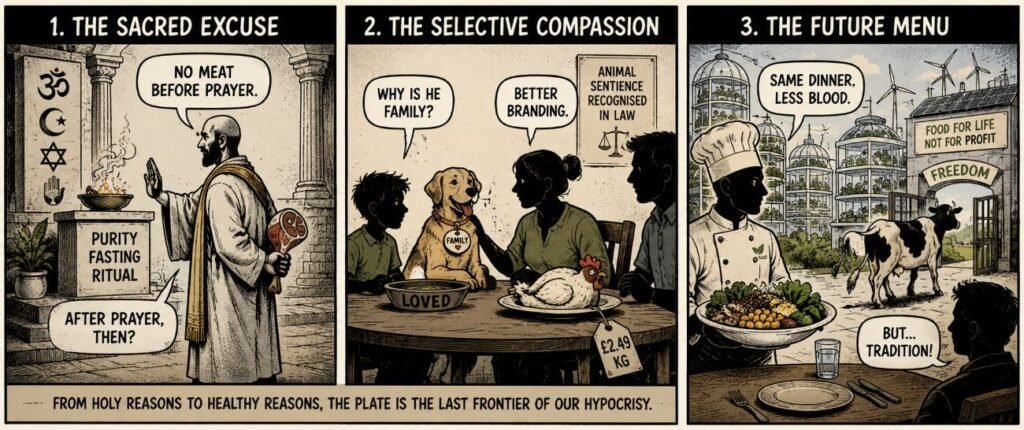
Scene 1: The Ancient Fast
Panel description: A robed worshipper stands beside an altar labelled “purity” while hiding a sausage behind his back.
Dialogue: Priest: “No meat before prayer.” Worshipper: “After prayer, then?”
Scene 2: The Pet Exception
Panel description: A family hugs a dog at the table while a chicken silhouette sits on a plate beside a receipt.
Dialogue: Child: “Why is he family?” Adult: “Better branding.”
Scene 3: The Future Menu
Panel description: A greenhouse kitchen shows beans, grains, and lab equipment while a cow walks out through an open gate.
Dialogue: Cook: “Same dinner, less blood.” Customer: “But tradition!”
What to watch, not the show
- Meat marketing that turns appetite into identity.
- Governments that recognise animal sentience but move slowly when money enters the room.
- Food systems built around cheap volume, not mercy.
- Health debates that ignore planning, class, access, and education.
- Cultural hypocrisy around pets, farm animals, and “acceptable” suffering.
- Future agriculture, plant proteins, fermentation, and lab-grown food changing what counts as normal.
- The gap between spiritual purity in theory and daily consumption in practice.
The Hermit take
Compassion that stops at the pet bowl is still wearing a costume.
The cleaner plate is not always holy, but it is harder to lie to.
Keep or toss
Verdict: Keep / Toss.
Keep the honesty about nutrition and culture.
Toss the lazy excuse that suffering becomes fine when it is traditional.
Sources
- Britannica, Sanctity of the cow: https://www.britannica.com/topic/sanctity-of-the-cow
- Quran.com, Surah Al-Ma’idah 5:3: https://quran.com/en/al-maidah/3
- Chabad, Why Do Jews Not Eat Pork?: https://www.chabad.org/library/article_cdo/aid/1452611/jewish/Why-Do-Jews-Not-Eat-Pork.htm
- Britannica, Jainism: https://www.britannica.com/topic/Jainism
- Britannica, Dietary law and Buddhism: https://www.britannica.com/topic/dietary-law/Hinduism
- NHS, The vegetarian diet: https://www.nhs.uk/live-well/eat-well/how-to-eat-a-balanced-diet/the-vegetarian-diet/
- Our World in Data, More than 80 billion land animals are slaughtered for meat every year: https://ourworldindata.org/data-insights/billions-of-chickens-ducks-and-pigs-are-slaughtered-for-meat-every-year
- German Federal Statistical Office, Global meat production and consumption: https://www.destatis.de/EN/Themes/Countries-Regions/International-Statistics/Data-Topic/AgricultureForestryFisheries/livestock_meat.html
- FAO, New report maps pathways towards lower livestock emissions: https://www.fao.org/newsroom/detail/new-fao-report-maps-pathways-towards-lower-livestock-emissions/en
- GOV.UK, Animal Sentience Committee and Animal Welfare (Sentience) Act 2022: https://www.gov.uk/government/publications/animal-sentience-committee-impact-of-definitions-of-animals-in-law/animal-sentience-committee-welfare-implications-of-legislative-differences-in-the-definition-of-animals
