
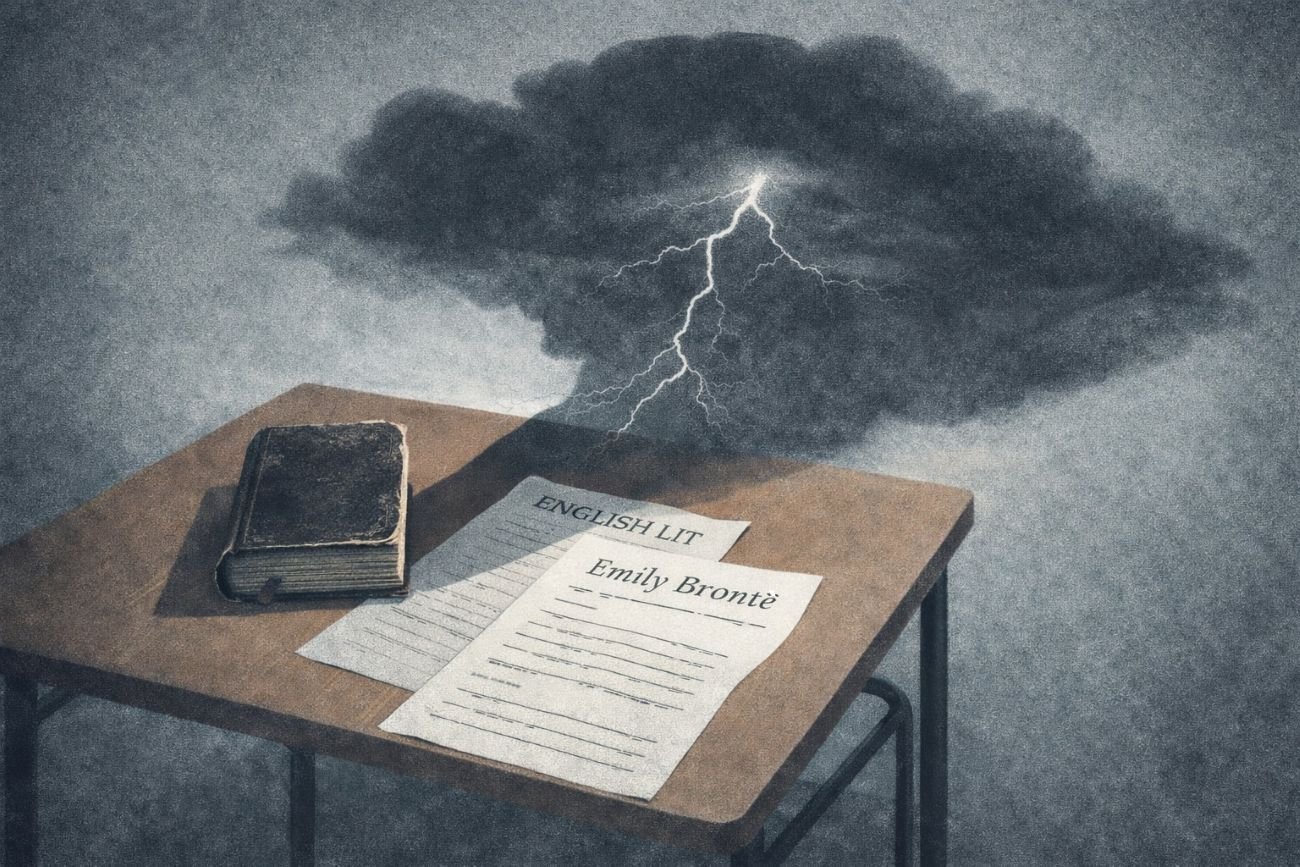
Lede
Emily Brontë wrote one novel, then quietly forced the entire culture to keep rereading it forever.
Hermit Off Script
Here is the flex: born in 1818, dead in 1848, and in between she produces Wuthering Heights (1847) and basically invents a new emotional weather system. One book. Not a trilogy, not a cinematic universe, not “Book 1 of 9”. Just one dense, strange, ferocious novel that still embarrasses lighter fiction with its stamina. And because the nineteenth century loved a gate, she published under a male pen name, Ellis Bell, because women writers were expected to be charming, not volcanic. The result is delicious: the industry tries to shrink her, and she responds by writing a story that refuses to behave. If you want to get into her work, do not start by asking whether you “like” the characters. Start by watching what she does with voice, with landscape, with the idea that love can be both devotion and violence in the same breath. Read the novel, then read her poems, because the poetry is where you see the stillness behind the storm. She co-published a poetry collection with her sisters in 1846, under the Bell names, and it is the quiet doorway into her imagination. There is also the myth machine: portraits, moor walks, museum pilgrimages, endless adaptations. The Brontë Parsonage Museum in Haworth holds major collections and keeps the whole thing alive, which is both beautiful and faintly funny: one private writer becomes a public industry.
So yes, this is a roast, but it is affectionate. Emily Brontë did not “create content”. She created consequences.
What does not make sense
- She wrote one novel and still gets more adaptations than authors with 10 books.
- A woman writes a masterpiece, so the era demands she pretend to be a man first.
- People insist on calling her work romance when it is clearly a Gothic pressure test.
- Modern culture keeps remaking her, then acts surprised that the result is uncomfortable.
Sense check / The numbers
- Emily Bronte lived from 30 July 1818 to 19 December 1848, and produced one novel, published in 1847. [Britannica]
- Wuthering Heights was published under the pseudonym Ellis Bell. [Britannica]
- The Bronte Parsonage Museum in Haworth describes itself as holding the largest collection of Bronte items in the world. [Bronte Parsonage Museum]
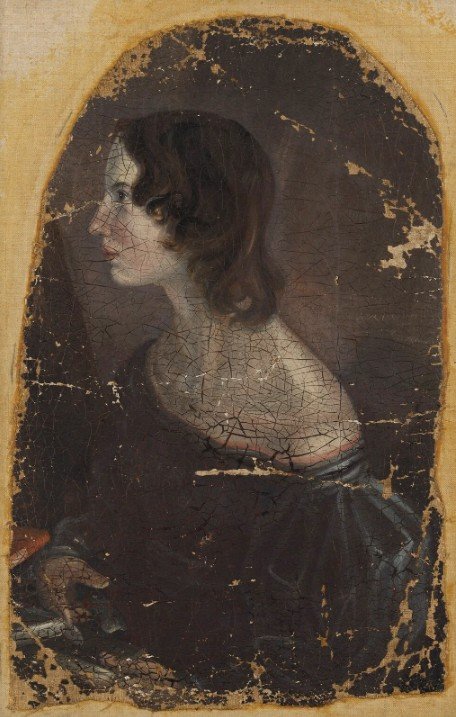
- The best-known surviving portrait of Emily is a fragment from a larger sibling group painting by Branwell Bronte. [National Portrait Gallery]
The sketch
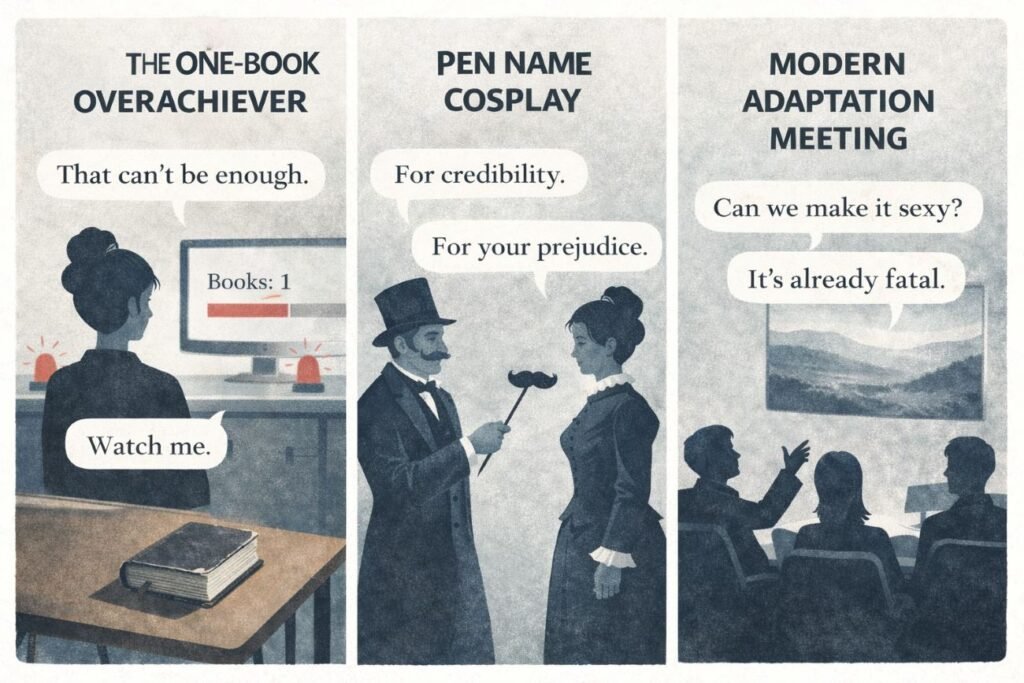
Scene 1: “The one-book overachiever”
Panel: A publishing dashboard shows “Books: 1”. Alarm lights flash.
Dialogue: “That can’t be enough.”
Dialogue: “Watch me.”
Scene 2: “Pen name cosplay”
Panel: A Victorian editor hands her a moustache-on-a-stick.
Dialogue: “For credibility.”
Dialogue: “For your prejudice.”
Scene 3: “Modern adaptation meeting”
Panel: A studio room. A moor is projected on the wall like evidence.
Dialogue: “Can we make it sexy?”
Dialogue: “It’s already fatal.”
What to watch, not the show
- How canon is made: schools, syllabuses, status, repetition.
- How publishing policed women’s voices, then profited from them later.
- How place shapes art: landscape as engine, not wallpaper.
- How myth replaces person: the fewer documents, the louder the legend.
- How adaptations can flatten what books keep feral.
The Hermit take
Emily Bronte is proof that one true book can outlive a thousand polite ones.
Read her for the language, and let the discomfort do its job.
Keep or toss
Keep
Keep the novel and the poems close.
Toss the idea that she was writing to be likeable.
Sources
- Britannica biography: https://www.britannica.com/biography/Emily-Bronte
- Britannica on Wuthering Heights: https://www.britannica.com/topic/Wuthering-Heights
- The British Library overview: https://www.britishlibrary.cn/en/works/emily-bronte-s-wuthering-heights/
- Bronte Parsonage Museum (home and collections): https://www.bronte.org.uk/
- National Portrait Gallery portrait page (Emily): https://www.npg.org.uk/collections/search/portrait/mw00800/Emily-Bront
- National Portrait Gallery acquisition history (Bronte group painting): https://www.npg.org.uk/collections/research/archive/archive-journeys/acquisition-histories/the-bronte-sisters-by-patrick-branwell-bronte-npg-1724-and-1725
- British Library Shop note (facsimiles referencing Poems 1846): https://shop.bl.uk/products/wuthering-heights-first-edition-facsimile?srsltid=AfmBOooIFvl1Vd5DAHznx7IUjaJBrNuxWbHSiJoXUTy42BPurc3gbZOG
- Project Gutenberg (Poems, 1846): https://www.gutenberg.org/ebooks/1019

2 responses
[…] you came for romance, Brontë hands you obsession, then asks you to call it […]
[…] went for Margot Robbie and the basic promise: take Brontë, take the moors, and show me what survives the jump to cinema. What I got was Emerald Fennell doing […]