
Lede
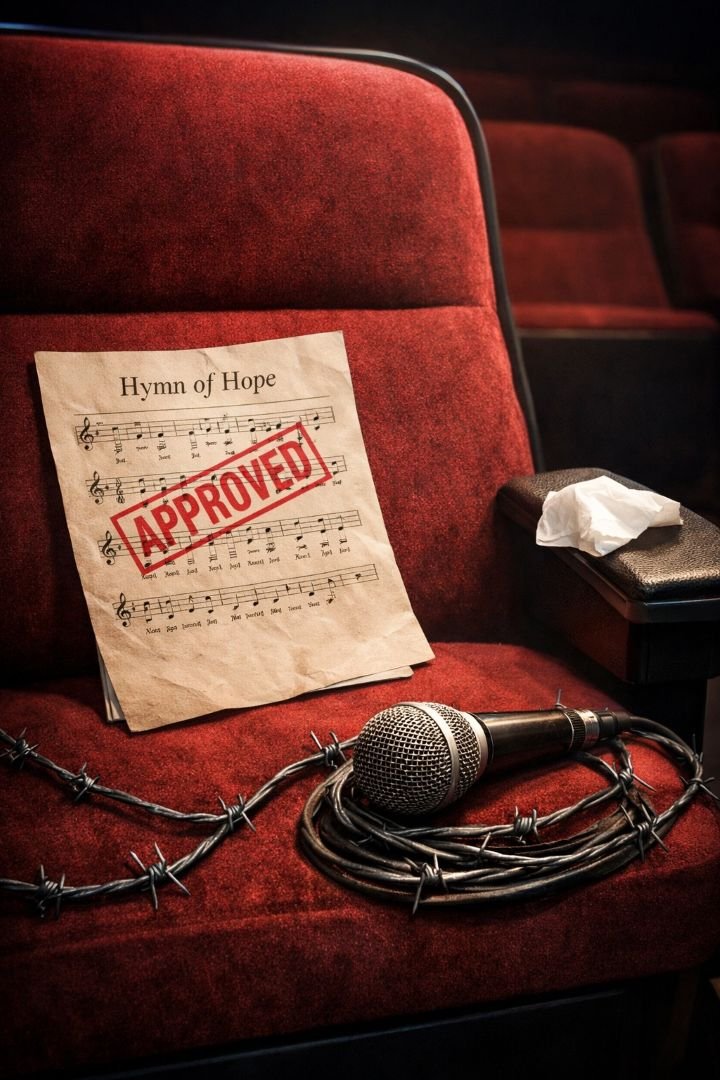
A film about a fake choir in a fake paradise somehow produces very real tears.
Hermit Off Script
Tears. I went into Choir of God expecting tears, honestly, and I got them, with a few comic beats in between like the film was apologising for making you feel too much. What surprised me was the setting. If I had been in the UK, I would have wanted this on streaming, not in a cinema, not a UK cinema at least. But in Seoul, it made a difference. The room had that clean comfort and solid sound that lets a film breathe, and the audience mattered too. It was mostly elderly people, with a few youngsters, and it was close to full, over a hundred. And I noticed tears in the eyes of some of the older viewers, the kind of tears that are not for show. It hit me how strange it is, watching a North Korean story made for South Koreans, or maybe for people who escaped, while sitting next to faces that looked like they were carrying decades.
And it dragged my mind back to my own country. Nearly 36 years after 1989, we still have people romanticising the cage, talking about the old days like the bars were a design feature. I remember being 14 and crying with happiness when the regime fell, knowing people had died so we could breathe. Now polls say nostalgia is not a fringe hobby. It is mainstream. Watching this, I kept thinking: if you miss the past, at least be honest about what you are missing. Freedom is precious because it is easy to waste.
Choir of God (2025) | Movie trailer
Choir of God (2025) – Movie synopsis roast
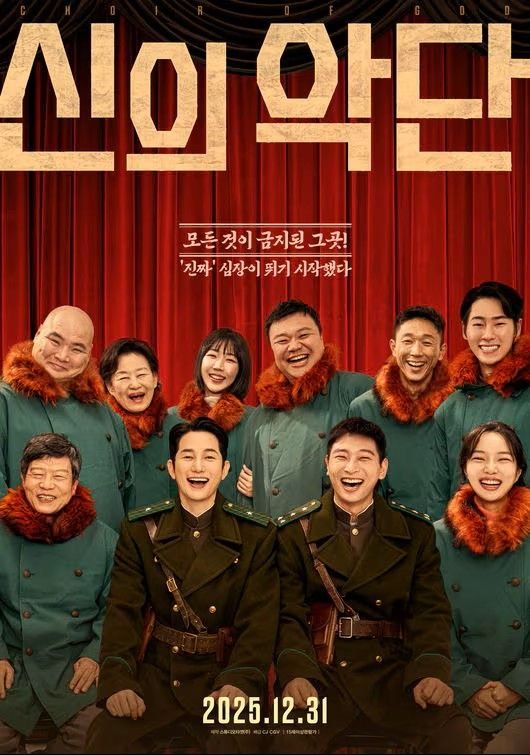
Choir of God is what happens when a regime tries to invoice heaven.
North Korea needs foreign currency, so an officer is told to stage faith like a product launch: build two churches in Pyongyang, host a revival, wheel out a choir, collect the money. KOFIC’s logline is blunt: the carrot is $200 million, the plan is a fake choir assembled from a ragtag band.
The joke, of course, is that once you force people to sing together, the singing starts doing what it has always done: it makes people human in public. The officer can choreograph smiles, rehearse piety, and standardise applause, but he cannot fully control what happens when voices hit the same note at the same time. Even the marketing pitch leans on that irony: a fake praise group formed for foreign-currency reasons, leading to unexpected events.
So you get a film that wears musical drama as camouflage, then quietly turns the blade: propaganda wants performance without belief, but music has a nasty habit of smuggling belief back in, not necessarily religious belief, just the dangerous kind where people remember they have an inner life. And that is the real punchline. The state orders a choir to sell sincerity. The choir accidentally finds it.
Cast and credits
Director: Kim Hyeong-hyeop
Genre: Drama, Human Drama
Main cast: Park Si-hoo, Jeong Jin-woon, Tae Hang-ho, Jang Ji-gun, Han Jung-wan
Production company/studio: Studio Target
Runtime: 110 minutes (KOFIC) vs 1h 55m (Rotten Tomatoes)
Release year and platform: 2025, theatrical release in South Korea (Dec 31, 2025 listed by KOFIC)
What does not make sense
- A state built on control trying to rent legitimacy by staging a “revival”.
- Foreign currency desperation dressed up as “culture”, as if sanctions can be solved with harmony.
- Churches as a transaction: build 2, receive $200 million, call it spiritual.
- Comedy stitched into trauma, and somehow the comedy is what makes the trauma hit harder.
- People praising authoritarian “stability” while also admitting there was no freedom.
Sense check / The numbers
- KOFIC lists the premise as an international NGO offering $200 million if 2 churches are built in Pyongyang, prompting a North Korean officer to assemble a fake choir. [KOFIC]
- KOFIC lists release date Dec 31, 2025, running time 110 minutes, and a 15 rating. [KOFIC]
- KOFIC box office totals (as of Jan 3, 2026): 498 screens, 93,330 admissions, $583,847 total gross. [KOFIC]
- Rotten Tomatoes lists runtime as 1h 55m and categorises it as Music, Drama, with Studio Target as production company. [RottenTomatoes]
- Romania nostalgia data often cited from an INSCOP survey: 55.8 per cent say the communist regime was “rather a good thing”, 66.2 per cent rate Ceausescu as a good leader, and the sample size is 1,505 adults. [Euronews]
The sketch
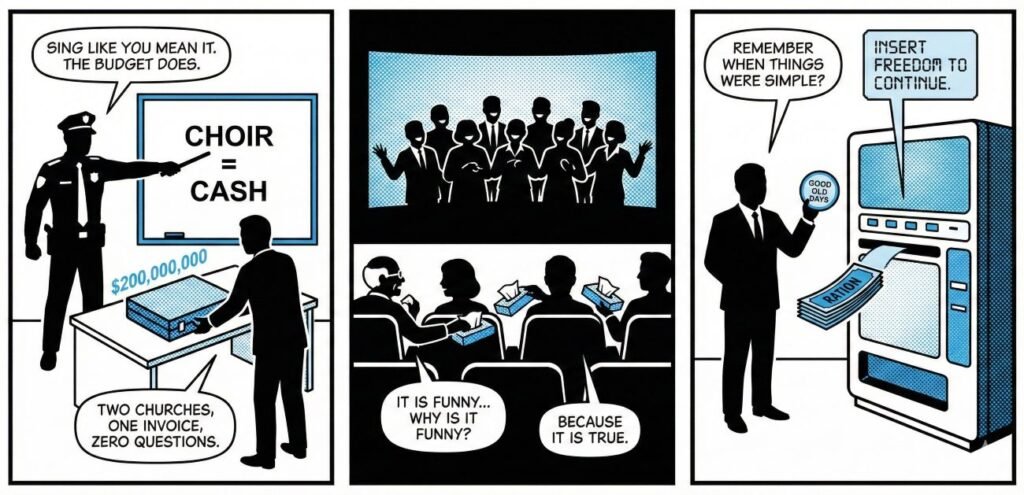
Scene 1: “Sanctions Karaoke”
Panel: A stern officer points at a whiteboard: “CHOIR = CASH”. An NGO rep slides a briefcase labelled “$200,000,000”.
Dialogue:
Officer: “Sing like you mean it. The budget does.”
NGO rep: “Two churches, one invoice, zero questions.”
Scene 2: “The Tissue Economy”
Panel: A Seoul cinema row passes tissues down the line like communion. On-screen, a smiling chorus freezes mid-note.
Dialogue:
Elderly viewer: “It is funny… why is it funny?”
Friend: “Because it is true.”
Scene 3: “Nostalgia Vending Machine”
Panel: A politician sells “GOOD OLD DAYS” tokens. The machine dispenses ration coupons and silence.
Dialogue:
Politician: “Remember when things were simple?”
Machine: “INSERT FREEDOM TO CONTINUE.”
What to watch, not the show
- Sanctions and the black-market logic of “earn foreign currency by any story necessary”.
- Propaganda as theatre: the performance matters more than the belief.
- NGOs and soft power incentives that can be gamed by regimes.
- How audiences with lived history react differently than tourists to pain.
- Nostalgia politics: disappointment in the present gets recycled into myth about the past.
The Hermit take
A musical about lies that tells the truth by accident.
If you miss the cage, watch the lock close in tune.
Keep or toss
Keep
Keep the emotional honesty and the satirical engine.
Toss the comforting idea that nostalgia is harmless, because it recruits quietly and votes loudly.
Sources
- KOFIC film entry (synopsis, release date, runtime, box office): https://www.koreanfilm.or.kr/eng/films/index/filmsView.jsp?movieCd=20247457
- Rotten Tomatoes listing (runtime, genre, production company): https://www.rottentomatoes.com/m/choir_of_god
- Euronews on INSCOP results (percentages, sample size): https://www.euronews.com/my-europe/2025/07/25/shock-poll-claims-romanians-are-nostalgic-for-communist-dictator-nicolae-ceausescu-who-was
- INSCOP media page referencing the July 2025 poll coverage: https://www.inscop.ro/en/category/media-en/2025-en/
