
Lede
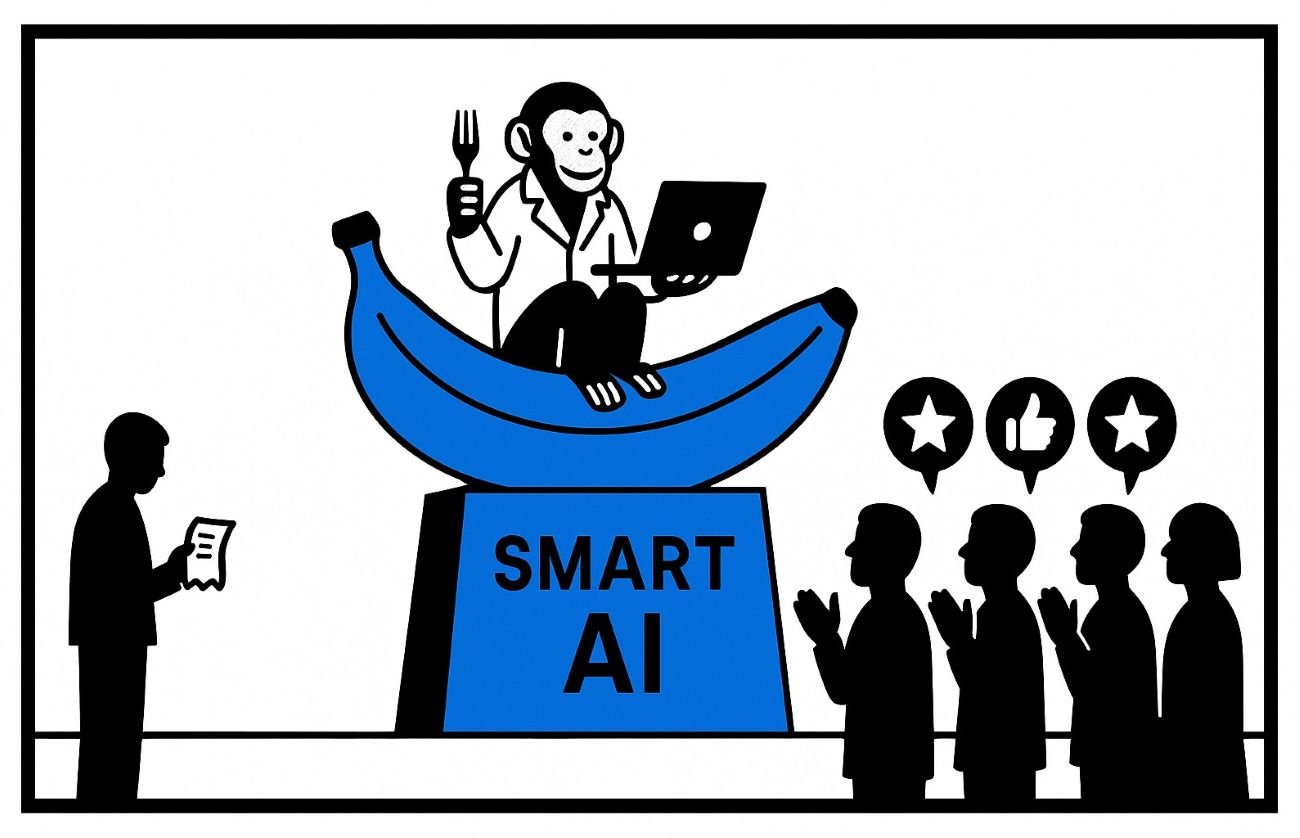
We are paying premium prices for tools that think like monkeys with forks while reviewers write sonnets about their genius.
Hermit Off Script
What annoys me lately is how banana pro is somehow treated like a breakthrough when it thinks like a monkey that just learned how to eat with a fork. It can follow tools, sure, but the moment it has to think, it goes whole zoo exhibit. Then there is Gemini, suddenly mainstream and paraded as the clever one, yet, outside the so-called deep-thinking mode, it feels like the dumbest thing you could use for daily tasks. I genuinely cannot explain that rise except by assuming most high-profile reviewers are paid, or at least happily sponsored, to praise these stupid releases. At the same time, only a few voices still call them what they are: dumb models trained on a pile of data, wrapped in marketing about smartness. Yes, they spit out images and essays that sound clever, but read three in a row, and you see the same lines shuffled like a cheap card trick. The only thing that even looks interesting is the long, extensive thinking flavour of GPT 5 point something, and even that still feels dumb as hell. The rest are blank. Tools, nothing more. Yet they are sold back to us as near divine minds, because money has to be pulled from our pockets. Agentic AI is hyped as the next revolution, but right now, it is even more useless and niche, a toy for demos and reviewers selling us stories, not a thing anyone sane would pay for. This roast is for every high-praising AI reviewer still pretending this circus is wisdom.
What does not make sense
- Calling a tool that fumbles basic reasoning a breakthrough while marketing it as your new genius colleague.
- Selling Gemini tiers as life-changing productivity, while most people use them to rewrite emails and poke at half-baked ideas.
- Treating hallucinations as a quirky personality, not as a core failure in a product you pay a subscription for.
- Reviewers praising every new release as revolutionary, then quietly admitting in footnotes that you still need to double-check everything.
- Calling it agentic AI while the so-called agents mostly chain shallow tasks and still need you to babysit every step.
- Charging Ultra prices for models that remix old sentences, then acting surprised when users notice the originality is skin deep.
Sense check / The numbers
- The global market for generative AI chatbots was worth about 7.66 billion dollars in 2024 and is projected to hit around 65.94 billion dollars by 2032, roughly a 9x jump in eight years.
- Overall generative AI revenue across tools and services was about 16 billion dollars in 2024 and is forecast to reach 85 billion dollars by 2029, a compound annual growth rate near 40 per cent.
- Gemini keeps getting pushed partly because the price is baked into clean subscription stories: the individual Gemini Advanced plan sits around 19.99 dollars per month, with business users often paying 20 to 55 dollars per user each month.
- A survey cited by Tidio found 72 per cent of people say they trust AI chatbots to give correct and reliable information, yet 75 per cent of those same people say they have been misled by a chatbot at least once.
- Another report highlighted that only about 8 per cent of users consistently check AI answers for accuracy, meaning over 90 per cent often accept outputs without verification, even while knowing hallucinations are a thing.
- The UK AI Safety Institute tested 19 leading models with roughly 80,000 people and found chatbots can meaningfully sway political opinions while still producing substantial amounts of inaccurate information.
- From 2014 to October 2024, there were about 13,574 recorded AI incidents globally, covering bias, safety failures, and misuse, yet the marketing still calls this progress friction rather than fundamental risk.
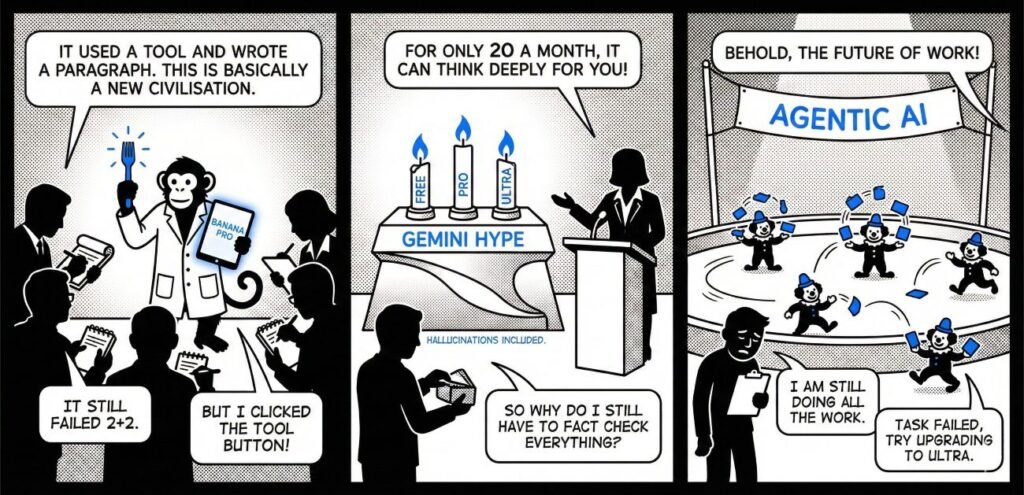
The sketch
Scene 1: Monkey with a fork
Panel description: A smug monkey in a lab coat holds a fork and a glowing “banana pro” tablet while tech journalists crowd around taking notes.
Dialogue:
Reviewer: “It used a tool AND wrote a paragraph. This is basically a new civilisation.”
User: “It still failed 2+2.”
Monkey: “But I clicked the tool button!”
Scene 2: Gemini altar call
Panel description: A sleek shrine labelled “Gemini Hype” with three subscription tiers as candles: Free, Pro, Ultra. A normal user opens their wallet while a reviewer in a blazer preaches.
Dialogue:
Reviewer: “For only 20 a month, it can think deeply for you!”
User: “So why do I still have to fact check everything?”
Tiny caption on altar: “Hallucinations included.”
Scene 3: Agentic circus
Panel description: A chaotic circus ring called “Agentic AI.” Tiny clown agents juggle tasks, drop them, and run in circles. A tired user holds a clipboard.
Dialogue:
Ringmaster reviewer: “Behold, the future of work!”
User: “I am still doing all the work.”
One small clown agent: “Task failed, try upgrading to Ultra.”
What to watch, not the show
- Subscription maths: the real intelligence is in pricing ladders, not the models.
- Reviewer incentives: ad money, affiliate links, and early access make honest boredom a career risk.
- Benchmark theatre: cherry-picked tests that never match your messy, real-life tasks.
- Data smoke: hallucinations and errors framed as charming quirks instead of defects in products that now run hospitals, courts, and markets.
- Agentic spin: chain-of-things demos that look slick on stage but collapse in uncurated workflows.
- Power shift: control of knowledge flows drifting from public institutions to a handful of companies with revenue targets the size of small countries.
- Trust erosion: a population that mostly does not check outputs, while tools are becoming more persuasive than many humans.
The Hermit take
Treat these things as spanners, not sages, and most of the nonsense melts away. The real danger starts when you let the marketing team define what intelligence is.
Keep or toss
Verdict: Toss
Keep the idea that models are just tools and should be priced and judged as such.
Toss the worship of banana pro, Gemini, and every agentic circus act as if they are new gods, plus the reviewers who keep bowing for a free subscription.
Sources
- Generative AI chatbot market size 2024 and 2032 forecast – https://resourcera.com/data/artificial-intelligence/ai-market-size/
- Generative AI total market revenue and 2029 forecast – https://www.spglobal.com/market-intelligence/en/news-insights/research/generative-ai-market-revenue-projected-to-grow-at-a-40-cagr-from-2024-2029
- Gemini Advanced individual and enterprise pricing – https://www.cloudeagle.ai/blogs/blogs-google-gemini-pricing-guide
- Overview of Gemini versions, features, and positioning – https://www.androidcentral.com/apps-software/google-gemini
- Tidio survey on trust in chatbots and users being misled – https://alhena.ai/blog/chatbot-hallucination/
- Exploding Topics report on how few users check AI answers – https://www.inc.com/jessica-stillman/are-you-too-trusting-of-ai-answers-92-percent-of-people-dont-check-it-for-accuracy/91209990
- OECD count of 13,574 AI incidents from 2014 to October 2024 – https://www.lgresearch.ai/blog/view?seq=495
- UK AI Safety Institute study on chatbots swaying opinions while being inaccurate – https://www.theguardian.com/technology/2025/dec/04/chatbots-sway-political-opinions-substantially-inaccurate-study
