
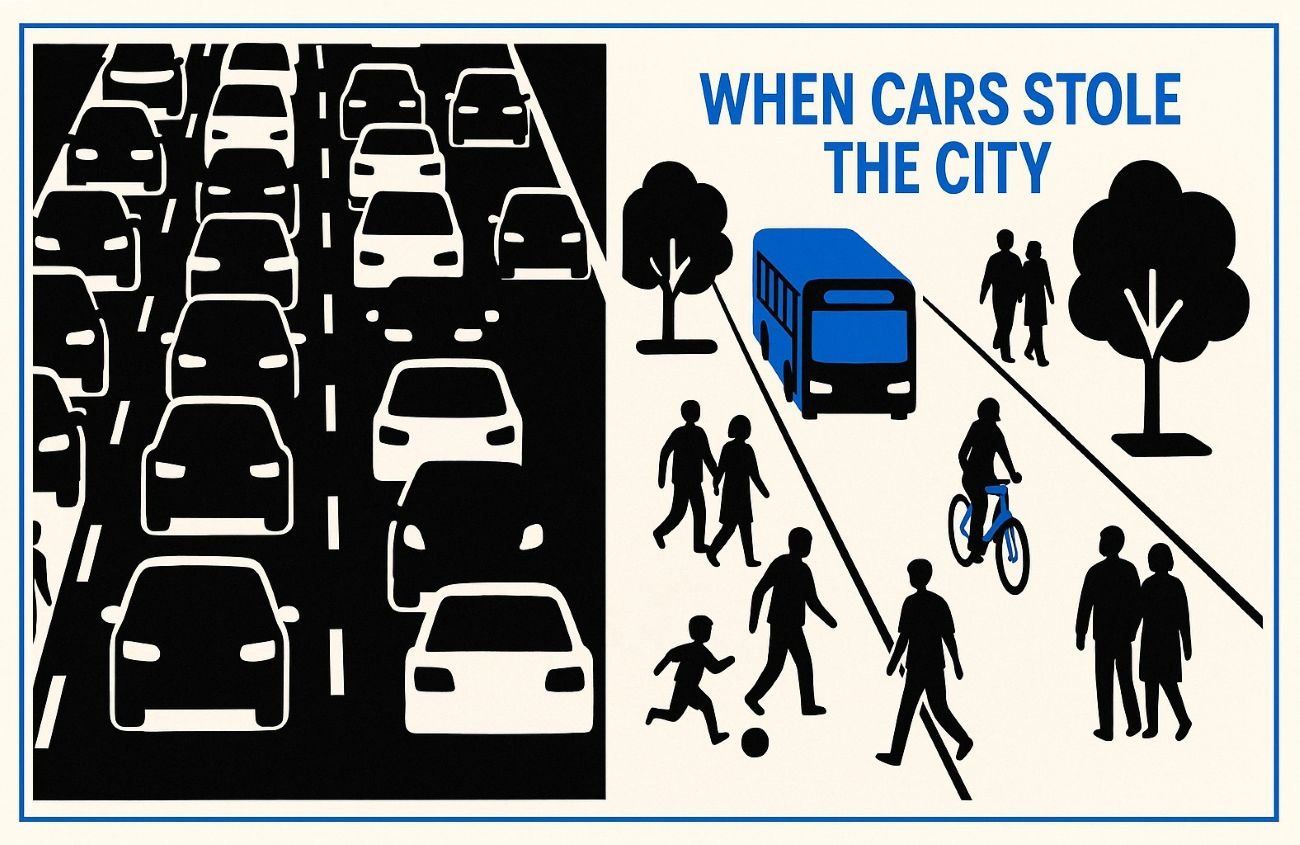
Lede
We redesigned entire cities so that a ton of metal on four wheels could feel more comfortable than the people who live there.
Hermit Off Script
Cars. Honestly, if I could, I would shove every last one of them underground and let buses and trams have the daylight. They keep selling us this greener future, yet every junction looks like a lung test gone wrong, and the pavements feel like a narrow afterthought. Streets are not built for bicycles or pedestrians; they are built for anything that can scream with an engine, a horn, or some fake spaceship noise from a battery pack. And yes, even the battery ones are not some holy green miracle when you count the mining, the factories, and the junk they leave behind. We act as if it were not the cars, herds of cows would be out there polluting instead, as if nature invented gridlock. Meanwhile, we live in this shiny tech age where robots can shuffle parcels and food underground, or above ground, or in some augmented reality maze, but somehow we still cannot give people a quiet, safe street to walk on. One day, the roads might actually belong to us again. Until then, we stand on the edge of our own cities, watching the traffic go by as if we were intruders.
What does not make sense
- We call it a public street, then hand most of it to private metal boxes that sit parked 95 per cent of the time.
- Cities talk about green transition while designing roads where a cyclist is treated as a moving traffic cone, not a person.
- Electric cars get sold as salvation while their batteries chew through mines, water, and rare metals so we can still queue alone in traffic.
- Pedestrians are told to be careful, look both ways, press buttons and wait, while drivers get the green wave and a marketing slogan about freedom.
- We have the tech to send robots to warehouses and parcels to the door, but apparently not the courage to take one lane away from cars.
Sense check / The numbers
- Road transport is responsible for about 15 per cent of global CO2 emissions, and passenger vehicles are the biggest chunk of that pie. [Our World in Data]
- In 2023, cars and vans emitted about 3.8 gigatonnes of CO2, more than 60 per cent of all road transport emissions. [IEA]
- Cars and vans make up around 48 per cent of global transport CO2 emissions, making them the single largest source within the transport sector. [Statista / IEA]
- Outdoor air pollution causes an estimated 4.2 million premature deaths per year worldwide, and almost 7 million when you include indoor pollution too. Transport is a major contributor in cities. [WHO]
- In Amsterdam, cars get 51 per cent of road space while cyclists, who often outnumber cars on key routes, get only 7 per cent of it. Many main streets worldwide dedicate over 70 per cent of space to vehicles. [Urban Cycling Institute / Transform Transport]
The sketch
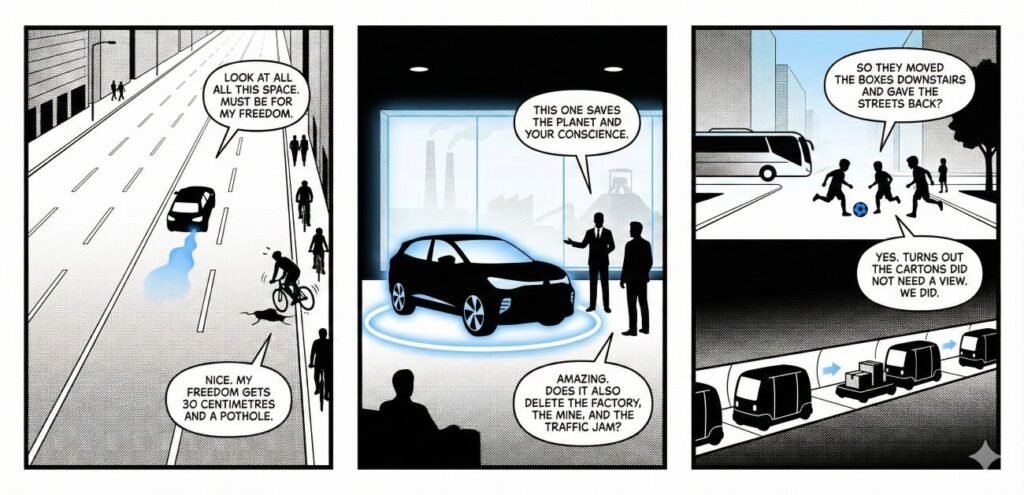
Scene 1: VIP Lane
Panel description: A wide city boulevard where a single car crawls along in a massive multi-lane road. Cyclists and pedestrians are squeezed into a skinny strip on the side.
Dialogue:
Car driver: “Look at all this space. Must be for my freedom.”
Cyclist, wobbling in a gutter lane: “Nice. My freedom gets 30 centimetres and a pothole.”
Scene 2: The Greenwash Showroom
Panel description: A slick car showroom with a glowing green halo around an electric SUV. In the background, a mine and smokestacks are faintly visible through the glass.
Dialogue:
Salesperson: “This one saves the planet and your conscience.”
Customer: “Amazing. Does it also delete the factory, the mine, and the traffic jam?”
Scene 3: The Underground Upgrade
Panel description: Underground tunnel full of automated pods carrying parcels and cargo. Above ground, kids play football in a quiet car-free street while a bus glides past.
Dialogue:
Kid 1: “So they moved the boxes downstairs and gave the streets back?”
Kid 2: “Yes. Turns out the cartons did not need a view. We did.”
What to watch, not the show
- Car industry lobbying that keeps private cars at the centre of every transport plan.
- Political cowardice about taking actual road space from cars and giving it to buses, bikes, and feet.
- Greenwash that swaps engines for batteries but keeps the same traffic, noise, and land grab.
- Urban design that treats parked cars as more important than trees, benches, or safe crossings.
- Media narratives that frame car reduction as a “war on drivers” instead of a life upgrade for everyone else.
- Tech fantasies about flying taxis and robotaxis while basic buses and trams still crawl in car traffic.
The Hermit take
A sane city is one where people, not parked steel, get first claim on the street.
If we keep designing for cars, we should not pretend to be shocked when the city feels unlivable for humans.
Keep or toss
Toss.
Keep buses, trams, bikes, and your own feet.
Toss the cult of private cars owning every inch of the street and pretending that swapping fuel type is enough.
Sources
- Our World in Data – CO2 emissions from transport and road share:
https://ourworldindata.org/co2-emissions-from-transport - IEA – Cars and vans emissions 2023:
https://www.iea.org/energy-system/transport/cars-and-vans - Statista / IEA – Cars and vans share of transport emissions:
https://www.statista.com/chart/30890/estimated-share-of-co2-emissions-in-the-transportation-sector/ - WHO – Ambient outdoor air pollution and premature deaths:
https://www.who.int/news-room/fact-sheets/detail/ambient-(outdoor)-air-quality-and-health - WHO – Air pollution responsible for 6.7 million premature deaths every year:
https://www.who.int/teams/environment-climate-change-and-health/air-quality-and-health/health-impacts/types-of-pollutants - Urban Cycling Institute – Road space distribution in Amsterdam:
https://urbancyclinginstitute.org/is-there-such-a-thing-as-a-fair-distribution-of-road-space/ - Transform Transport – Street space vs street proportions:
https://transformtransport.org/media/articles/street-space-vs-street-proportions/
