Lede
Everyone is shouting about AI killing art while quietly feeding it their life’s work for free.
Hermit Off Script
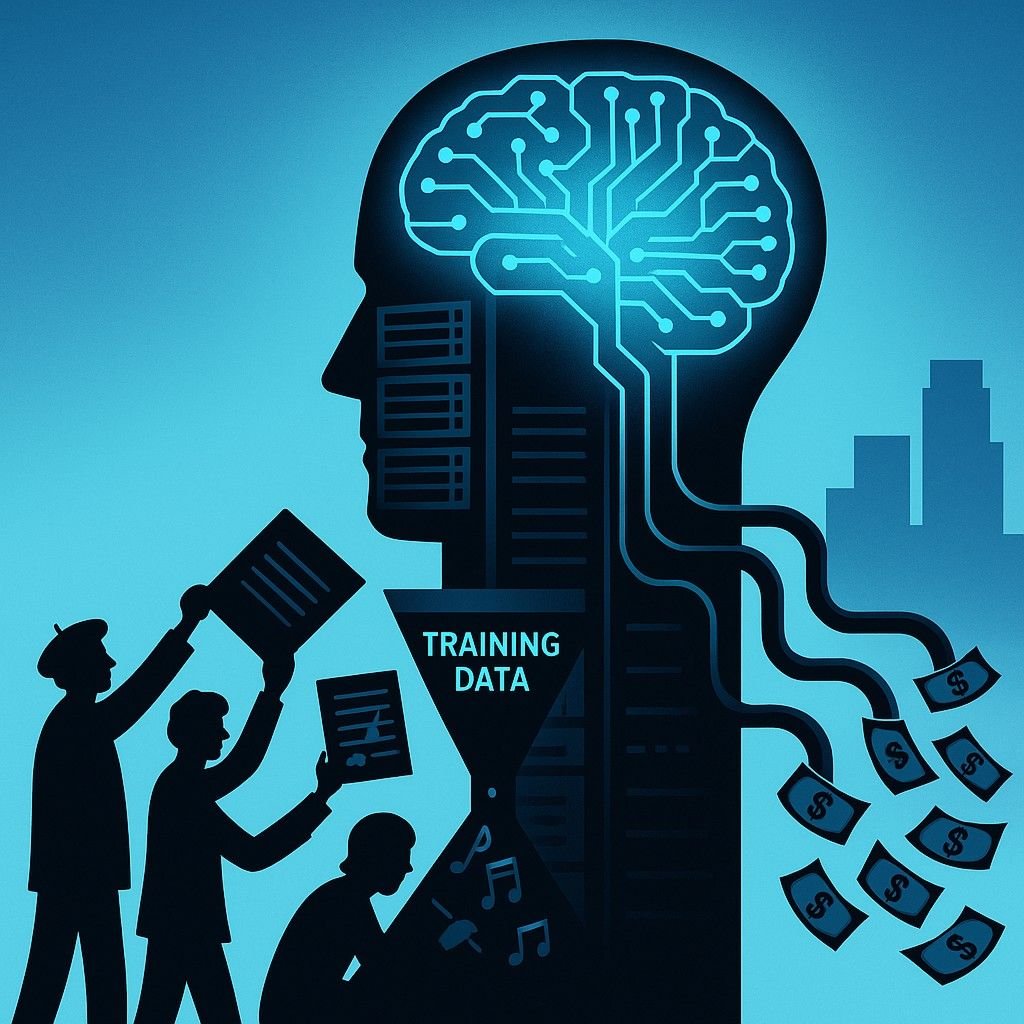
What annoys me most is this fake holy war against AI tools from the same people who would happily sell you a £500 course on “finding your muse online”. Right now these things are just that: tools. No matter how many TED friendly sermons the self appointed prophets of the AI race keep preaching. The loudest rage comes from successful artists, writers, designers, and authors, while the rest sprint toward the cheapest tools on earth to make discount copies of them. Because, honestly, doing it tooth and nail as a self-publisher, paying for cover art, promo videos, and everything else, was always brutal. Now the cost drops, the quality creeps from amateur to almost pro if you have some eye for design, and everyone panics that agents and AI will soon outdraw half the professional field. And I get why they are furious: their work was scraped, sliced, and fed into these models so a handful of companies can leap from billionaire to trillionaire territory. You wake up one day and realise your paintings and books trained the thing that is undercutting you. The punchline is that this is probably just the warm-up. Once AI stops chewing only on our old creations and starts learning from its own discoveries, humans will be the ones training on AI hand-me-downs. We become the cover band to our own stolen back catalogue.
What does not make sense
- We are told “no one will need to work” while 20 to 40 percent of workers are already using AI at work on top of their normal job, not instead of it.
- Artists are lectured to “embrace the future” by people whose entire innovation is scraping their portfolios without asking.
- Companies say the models create “new” images while courts point out they literally store chunks of copyrighted art.
- We keep hearing AI is just a neutral assistant, yet its main business model is turning other people’s unpaid labour into licence fees and valuations with ten zeroes.
- Creators are told to adapt or die, but when they ask for consent, pay, or opt-out, the answer is that training data is suddenly “too big to track”.
Sense check / The numbers
- In January 2023, at least 3 named visual artists filed a class action against Stability AI, Midjourney, and DeviantArt over image generators trained on datasets that include their copyrighted work without consent.
- In August 2024, a US federal judge ruled that several AI companies illegally stored artists’ works in their systems, allowing parts of their images to be reproduced in generated outputs.
- Authors are doing the same fight: the Authors Guild and well-known writers have ongoing lawsuits claiming their books were copied at scale to train large language models, with cases now combined in New York as of April 2025.
- On the business side, about 78 percent of organisations reported using AI in 2024, up from 55 percent the year before, while official data still shows little impact on headline employment so far.
- McKinsey estimates that generative AI could add 0.1 to 0.6 percentage points to annual labour productivity growth through 2040, which sounds small until you realise it compounds, and none of those spreadsheets include “fair pay for training data” as a variable.
- A recent MIT and Oak Ridge simulation suggests current AI could replace work worth about 11.7 percent of US salaries, roughly 1.2 trillion dollars, if deployed fully. The question is who pockets that saving and who just hears “learn to prompt, darling”.
The sketch
Scene 1: The Free Buffet
Panel description: A conference stage, giant slide behind the speaker reading “AI: DEMOCRATISING CREATIVITY”. In the shadows, a conveyor belt feeds piles of paintings, manuscripts, and tracks into a grinder labelled “TRAINING DATA”.
Dialogue:
Speaker: “Our model learned from the best creators in the world.”
Artist in the audience: “Cool. Which ones did you pay?”
Scene 2: The Cheap Dreams Shop
Panel description: A neon shop called “PROMPT & PRAY”. One side shows a broke writer at a terminal generating “EPIC SAGA COVER” for £0.10. On the other side, a veteran cover artist looks at a bank app with the balance dipping.
Dialogue:
Writer: “Look, I can finally afford a cover.”
Artist: “Look, I can finally afford panic.”
Scene 3: The Reversed Classroom
Panel description: A classroom where a smug AI avatar is at the front writing equations and blueprints on a board. Rows of humans sit taking notes, labelled “ARTISTS”, “CODERS”, “LAWYERS”.
Dialogue:
AI: “Today’s lesson: new physics, new law, new style.”
Student whisper: “So we trained it on us, and now we study it?”

What to watch, not the show
- Training data consent: who gets asked, who is “assumed”, and who can truly opt out.
- Revenue sharing models between AI firms, labels, publishers, and the actual creators whose work fed the machine.
- Legal precedents around whether copying for training is fair use or mass infringement with a nice interface.
- Concentration of power as a few platforms sit between billions of users and almost all synthetic media.
- The shift from “AI as tool” to “AI as discovery engine”, where humans start learning from AI more than from lived experience.
- Labour policy: what happens when 10 to 12 percent of current work can be automated, but the savings are captured by shareholders, not workers.
The Hermit take
It is easy to shout that AI is stealing art; it is harder to admit we built the altar out of our own uploads and likes. If we do not set the rules now, we will end up begging licence terms from a brain we quietly raised on everything we ever made.
Keep or toss
Verdict: Keep / Toss
Keep the tools as leverage for the broke, the new, and the locked-out creators who finally get a way in.
Toss the cult of prophets, the training data theft, and the fantasy that a trillion-dollar model is “just a neutral brush” when it is eating the whole gallery.
Sources
- Art-law analysis of Andersen v. Stability AI and related artist lawsuits:
https://itsartlaw.org/art-law/artificial-intelligence-and-artists-intellectual-property-unpacking-copyright-infringement-allegations-in-andersen-v-stability-ai-ltd/ - NYU JIPEL overview of Andersen v. Stability AI and image originality questions:
https://jipel.law.nyu.edu/andersen-v-stability-ai-the-landmark-case-unpacking-the-copyright-risks-of-ai-image-generators/ - Artists’ class action against AI image generators (Stability AI, Midjourney, DeviantArt):
https://news.artnet.com/art-world/class-action-lawsuit-ai-generators-deviantart-midjourney-stable-diffusion-2246770 - Update on artist lawsuit against Stability AI and Midjourney allowed to proceed:
https://www.theverge.com/2024/8/13/24219520/stability-midjourney-artist-lawsuit-copyright-trademark-claims-approved - Report on US artists’ partial court victory over AI firms storing their works:
https://www.theartnewspaper.com/2024/08/15/us-artists-score-victory-in-landmark-ai-copyright-case - Authors Guild v OpenAI analysis and copyright claims for training data:
https://www.forensisgroup.com/resources/expert-legal-witness-blog/authors-guild-et-al-v-open-ai-inc-2023-present-artificial-intelligence-ai-copyright-lawsuit-and-legal-implications-for-creative-works - Coverage of combined US authors’ copyright lawsuits against OpenAI and Microsoft:
https://www.theguardian.com/books/2025/apr/04/us-authors-copyright-lawsuits-against-openai-and-microsoft-combined-in-new-york-with-newspaper-actions - McKinsey report on economic potential and productivity impact of generative AI:
https://www.mckinsey.com/capabilities/tech-and-ai/our-insights/the-economic-potential-of-generative-ai-the-next-productivity-frontier - McKinsey 2024 survey on AI and gen-AI adoption in organisations:
https://www.mckinsey.com/capabilities/quantumblack/our-insights/the-state-of-ai-2024 - US Federal Reserve note on measuring AI uptake in the workplace:
https://www.federalreserve.gov/econres/notes/feds-notes/measuring-ai-uptake-in-the-workplace-20240205.html - US Census and Stanford AI Index data on business AI adoption and employment impact:
https://www.census.gov/library/stories/2025/09/technology-impact.html - MIT and Oak Ridge Iceberg Index simulation on AI replaceable work share:
https://www.tomshardware.com/tech-industry/artificial-intelligence/mit-simulation-shows-ai-can-replace-11-7-percent-of-u-s-workers-worth-usd1-2-trillion-in-salaries-iceberg-index-tool-shows-jobs-are-affected-in-every-state-across-the-country - Reuters report on updated artist lawsuit against Stability AI and Midjourney:
https://www.reuters.com/legal/litigation/artists-take-new-shot-stability-midjourney-updated-copyright-lawsuit-2023-11-30/ - Analysis of fair use and news copyright issues in AI training (NYT and ANI style cases):
https://techpolicy.press/generative-ai-and-copyright-issues-globally-ani-media-v-openai - Warner Music Group and Suno settlement on licensed AI music models:
https://www.reuters.com/legal/litigation/warner-music-group-settles-copyright-case-with-suno-licensed-ai-music-2025-11-25/ - McKinsey 2023 state of AI survey on early gen-AI adoption:
https://www.mckinsey.com/capabilities/quantumblack/our-insights/the-state-of-ai-in-2023-generative-ais-breakout-year

One response
It’s a strange paradox—we’re all complaining about AI taking over, but many of the same people are the first to use it to make their lives easier. It really does boil down to control and ownership. We need a better understanding of what ‘creative ownership’ means in the age of AI.